Resorting to ordinances has always raised concern on violation of the spirit of separation of powers doctrine. While noting the rationales justifying the power to promulgate ordinances, analyze whether the decisions of the Supreme Court on the issue have further facilitated resorting to this power. Should the power to promulgate ordinances be repealed? (UPSC 2015)
Ordinance-making under Articles 123 and 213 is an exceptional power for urgent situations when the legislature is not in session, ensuring continuity of governance, but it can strain parliamentary democracy and separation of powers.
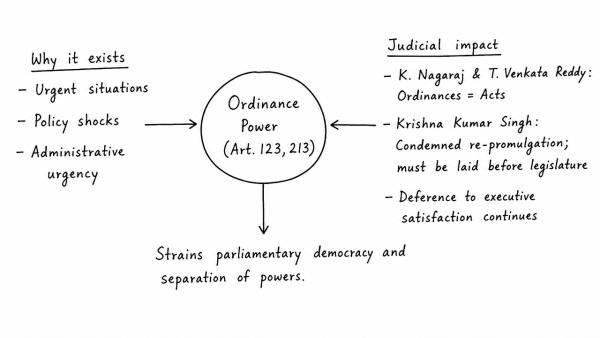
Why it exists and judicial impact: It addresses emergencies, policy shocks and administrative urgency. In K. Nagaraj and T. Venkata Reddy, ordinances were given the same force as Acts, enlarging executive discretion. Though Krishna Kumar Singh condemned re-promulgation and required laying before the legislature, it did not dilute the power itself. Judicial deference to executive satisfaction has therefore, at times, facilitated resort to ordinances rather than restrained it fully.
Repeal is unnecessary; the power should remain a narrow, time-bound exception, with strict legislative scrutiny, mandatory laying, and a complete bar on re-promulgation.