Religious indoctrination via digital media has resulted in Indian youth joining the ISIS. What is ISIS and its mission? How can ISIS be dangerous for the internal security of our country? (UPSC 2015)
ISIS is the Islamic State of Iraq and Syria, a transnational Salafi-jihadist terror group. It rose sharply in 2014 by declaring a self-styled caliphate in Iraq and Syria; though its territorial hold has collapsed, it survives through global affiliates and online networks.
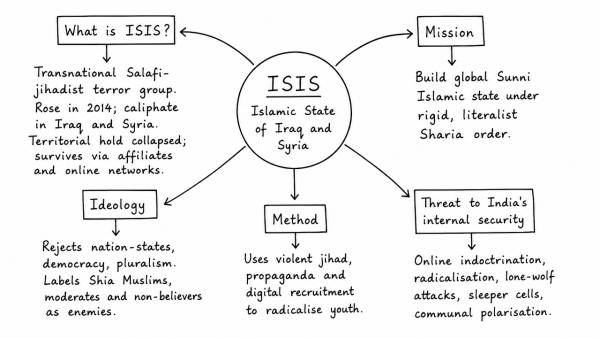
- Mission: To build a global Sunni Islamic state under a rigid, literalist Sharia order.
- Ideology: It rejects nation-states, democracy and pluralism, and labels Shia Muslims, moderates and non-believers as enemies.
- Method: Uses violent jihad, propaganda and digital recruitment to radicalise youth.
Threat to India’s internal security:
- Online indoctrination can create radicalised individuals and sleeper cells.
- It can inspire lone-wolf attacks on public places and critical infrastructure.
- Encrypted platforms and fake identities aid planning, recruitment and funding.
- It fuels communal polarisation, mistrust and social instability.
Thus, ISIS is not only a terror outfit but also an ideological threat. India needs strong cyber monitoring, intelligence sharing, de-radicalisation and community engagement to protect vulnerable youth and national security.
Originally written on
August 30, 2026
and last modified on
August 30, 2026.