Reforming the government delivery system through the Direct Benefit Transfer Scheme is a progressive step, but it has its limitations too. Comment. (UPSC 2022)
Direct Benefit Transfer has transformed welfare delivery by sending subsidies and entitlements directly to beneficiaries, reducing leakages, improving transparency and financial inclusion.
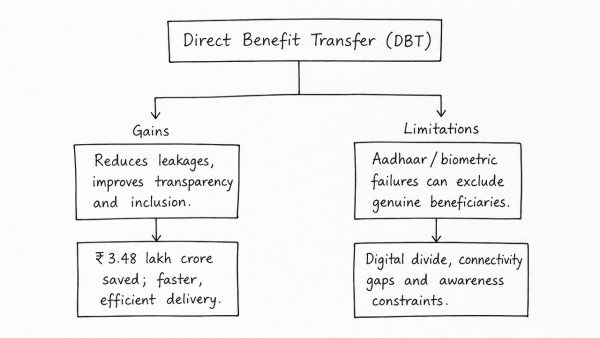
- Gains: DBT now covers 320 schemes across 56 ministries and has reportedly saved over ₹3.48 lakh crore by removing fake, duplicate and inactive beneficiaries.
- Cleaner delivery: De-duplication has reduced fake ration cards, LPG connections and job cards, improving targeting and use of public funds.
- Efficiency: It has made transfers faster, more accountable and better aligned with intended users.
- Limitations: Aadhaar or biometric failures can exclude genuine beneficiaries, while poor internet, weak banking access and low financial literacy especially hurt rural and marginal groups.
Thus, DBT is a progressive reform, but its gains are limited by exclusion errors, the digital divide, uneven state capacity and weak beneficiary control over accounts, requiring stronger authentication, connectivity and last-mile support.
Originally written on
September 3, 2026
and last modified on
September 3, 2026.