Rajya Sabha has been transformed from a ‘useless stepney tyre’ to the most useful supporting organ in the past few decades. Highlight the factors as well as the areas in which this transformation could be visible. (UPSC 2020)
Rajya Sabha has moved beyond being seen as a weak upper house. It now serves as an important federal, revising and stabilising chamber in India’s parliamentary system.
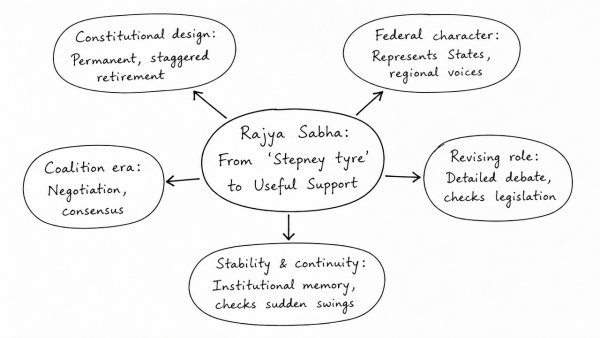
- Constitutional design: Under Article 80 and Article 83, it is a permanent House with staggered retirement. This gives continuity, institutional memory and a check against sudden legislative swings.
- Federal character: It represents States and Union Territories, so regional voices can influence national law-making.
- Coalition era: Since no single party has always dominated both Houses, negotiation and consensus have become necessary. Regional parties have gained greater bargaining power in the Upper House.
- Committee system: Detailed scrutiny in Department-related Standing Committees and Select Committees has improved debate quality and exposed flaws in Bills before passage.
- Expert and nominated members: The presence of nominated members with domain knowledge enriches discussion on law, science, economy and social policy.
- Visible areas of transformation: It has played a strong role in reviewing major laws such as GST, where state concerns were better protected.
- Policy correction: Intense scrutiny of contentious Bills, including the Triple Talaq legislation, has improved legislative debate and accountability.
- Federal safeguards: It has used special powers under Articles 249 and 312 in matters of national importance and All-India Services.
- Continuity during crises: Being a permanent House, it helps keep Parliament functional when the Lok Sabha is dissolved or disrupted.
However, its effectiveness is reduced when Money Bills are used to bypass it and when Bills are not referred to committees. Even then, Rajya Sabha remains a crucial supporting organ that strengthens federalism, deliberation and stability in Indian democracy.
Originally written on
September 2, 2026
and last modified on
September 2, 2026.