‘Quadrilateral Security Dialogue (QUAD) is transforming itself into a trade bloc from a military alliance in present times.’ Discuss. (UPSC 2020)
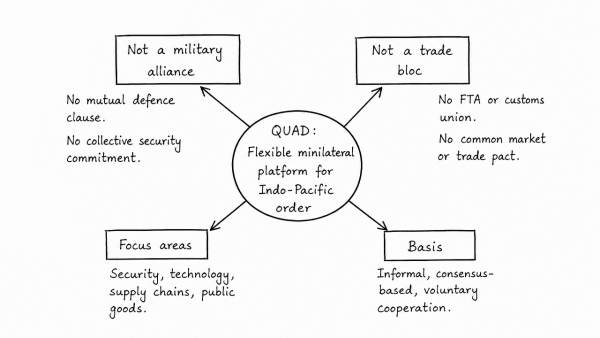
The Quad is not becoming a trade bloc in the conventional sense, nor is it a military alliance like NATO. It is evolving into a flexible minilateral platform that combines security, technology, supply chains and public goods to shape the Indo-Pacific order.
- Why it is not a military alliance
- There is no mutual defence clause or collective security commitment.
- It remains an informal dialogue based on consensus and voluntary cooperation.
- Its naval exercises and maritime coordination are aimed at interoperability and deterrence, not alliance obligations.
- Why it cannot be called a trade bloc
- The Quad does not offer preferential tariffs, market access or a common trade policy.
- It does not negotiate a common free trade agreement.
- Its economic work is issue-based, not built on formal trade integration.
- What is driving the economic turn
- Supply Chain Resilience Initiative seeks to reduce dependence on China-centric production networks.
- Work on critical minerals, semiconductors, AI, telecom and cyber security reflects strategic economic cooperation.
- Projects such as the Blue Dot Network, Quad Investors Network and ports cooperation promote transparent, resilient infrastructure.
- Health, disaster relief and maritime domain awareness show a wider public goods agenda.
- Security remains central
- Malabar exercises, maritime surveillance and information-sharing continue to address regional security challenges.
- Support for a rules-based maritime order and freedom of navigation remains a core objective.
The Quad is best understood as a strategic partnership with growing economic content. It is neither a military bloc nor a trade bloc, but a practical coalition balancing security, resilience and development in the Indo-Pacific.
Originally written on
September 2, 2026
and last modified on
September 2, 2026.