Pressure group politics is sometimes seen as the informal face of politics. With regards to the above, assess the structure and functioning of pressure groups in India. (UPSC 2013)
Pressure groups are the informal face of politics because they seek to influence policy without contesting elections. In India, they mediate between citizens and the state, articulating sectional interests through persuasion, protest and lobbying.
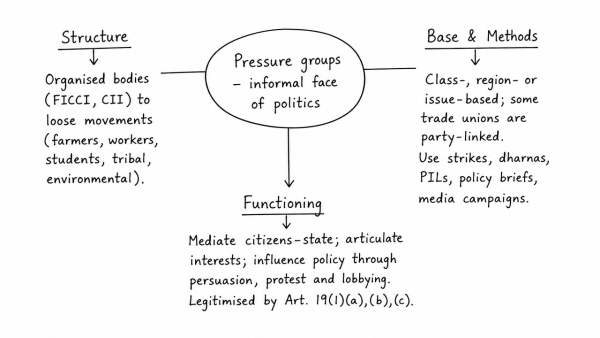
- Structure: They range from organised bodies like FICCI and CII to loose farmer, worker, student, tribal and environmental movements.
- Base and methods: Many are class-, region- or issue-based; some trade unions are party-linked, reducing autonomy. They are legitimised by Articles 19(1)(a), 19(1)(b) and 19(1)(c), and use strikes, dharnas, PILs, policy briefs and media campaigns.
- Functioning: They shape labour, land, environment and transparency agendas, but influence remains uneven due to unequal access, informal lobbying, weak internal democracy and funding constraints.
Thus, pressure groups enrich Indian democracy by voicing interests beyond parties, yet their role needs greater transparency, accountability and inclusiveness.
Originally written on
August 28, 2026
and last modified on
September 7, 2026.