Present an account of the Indus Water Treaty and examine its ecological, economic and political implications in the context of changing bilateral relations. (UPSC 2016)
The Indus Waters Treaty (1960), brokered by the World Bank, is a durable water-sharing pact: India got the eastern rivers Ravi, Beas and Sutlej, while Pakistan received the western rivers Indus, Jhelum and Chenab, with limited Indian use on the west.
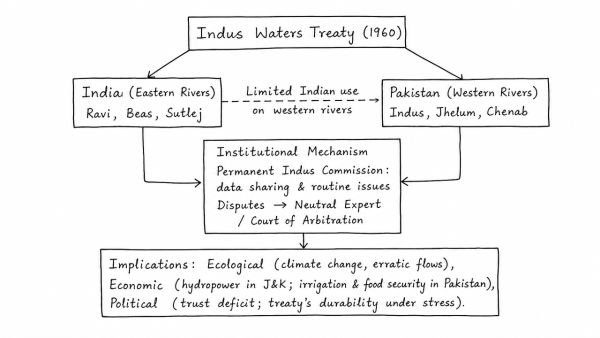
- Institutional design: The Permanent Indus Commission shares data and settles routine issues; disputes go to a Neutral Expert or Court of Arbitration.
- Ecological and economic effects: Climate change, glacier melt and erratic flows expose the treaty’s weak ecological focus. It supports hydropower in J&K and irrigation/food security in Pakistan, but disputes like Kishenganga and Ratle raise costs and delay projects.
Politically, water has become tied to trust deficit, sovereignty and terrorism, making the treaty both a symbol of resilience and a test of cooperation amid strained bilateral ties.
Originally written on
August 30, 2026
and last modified on
August 30, 2026.