Pradhan Mantri Jan Dhan Yojana (PMJDY) is necessary for bringing unbanked to the institutional finance fold. Do you agree with this for financial inclusion of the poor section of the Indian society? Give arguments to justify your opinion. (UPSC 2016)
Yes, PMJDY has been necessary to bring the unbanked into the institutional finance system. It has given millions of poor households a formal entry point into banking, enabled direct benefit transfers, and reduced dependence on moneylenders and intermediaries.
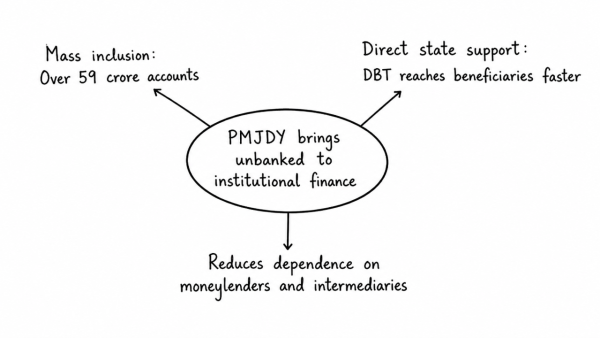
- Mass inclusion: Over 59 crore accounts have been opened, with a strong rural reach and a majority of women account holders. This shows deep outreach among excluded sections.
- Direct state support: PMJDY is the base of the JAM trinity. DBT of subsidies, pensions and wages now reaches beneficiaries faster and with less leakage.
- Social security access: Linked insurance and pension schemes have widened protection for the poor and informal workers.
- Digital and savings habit: RuPay cards, zero-balance accounts and mobile banking have encouraged small savings and cashless payments.
- Credit linkage: Regular account use can build a transaction record and improve access to formal credit and micro-loans.
- Limits: Many accounts remain dormant or are used only to withdraw welfare cash.
- Access gaps: Biometric failure, poor connectivity and weak financial literacy still restrict real inclusion.
- Shallow usage: Banking access has improved, but asset creation, savings depth and credit absorption remain limited.
Thus, PMJDY is indispensable as the first step, but financial inclusion of the poor needs stronger usage, literacy, last-mile service and affordable credit to become truly meaningful.
Originally written on
August 30, 2026
and last modified on
August 30, 2026.