“Poverty alleviation programmes in India remain mere showpieces until and unless they are backed up by political will.” Discuss with reference to the performance of the major poverty alleviation programmes in India. (UPSC 2017)
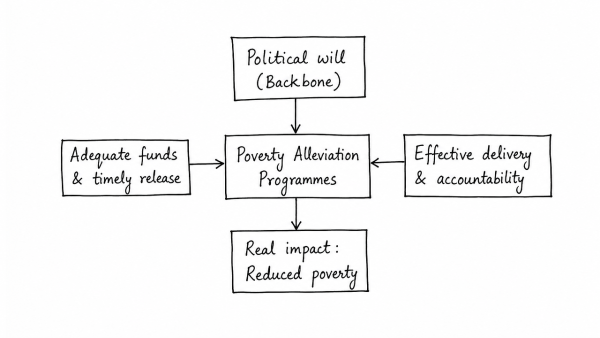
Poverty alleviation in India has seen many schemes, but results depend more on sustained political will than on announcements. Programmes can reduce deprivation only when backed by funds, delivery and accountability.
- Employment: MGNREGA has been a lifeline in distress years and proved that rights-based work can cut poverty. Yet delayed wages, work rationing and uneven state commitment reduced its impact. The proposed expansion of guaranteed days shows intent, but funding remains crucial.
- Food security: PM-GKAY covered over 81 crore beneficiaries and curbed extreme hunger during crisis years. However, it is mainly a consumption support measure and cannot alone generate livelihoods or assets.
- Assets and livelihoods: PMAY-G, Jal Jeevan Mission and DAY-NRLM show that political attention can scale up housing, drinking water and women’s incomes. The decline in multidimensional poverty from 29.17% in 2013-14 to 11.28% in 2022-23 reflects the value of such combined interventions, though execution gaps persist, as seen in reduced revised spending in JJM.
- Structural limits: Top-down design, weak devolution, digital exclusion, centre-state frictions and poor monitoring often turn schemes into fragmented relief rather than durable poverty removal.
Thus, poverty alleviation programmes become effective only when political will ensures adequate resources, timely implementation and decentralised accountability.
Originally written on
August 31, 2026
and last modified on
August 31, 2026.