Point out why India maintains strategic autonomy within the Quad. How does this posture affect the group’s transition into a formal military alliance? Critically discuss.
India sees the Quad as a platform for strategic cooperation, not bloc politics. Its stance is rooted in strategic autonomy: the freedom to decide issue by issue, preserve room for manoeuvre, and avoid binding military commitments.
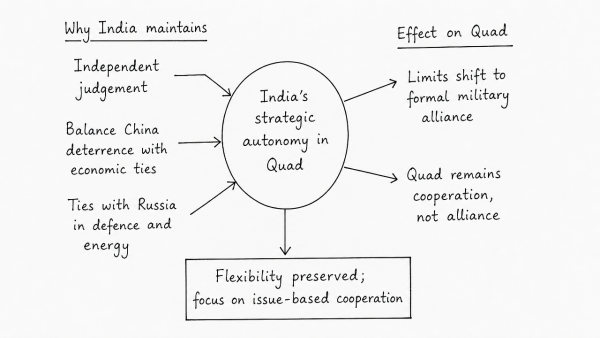
Why India prefers strategic autonomy
- Historical and doctrinal reasons: India’s non-alignment legacy now appears as strategic autonomy, with emphasis on independent judgement.
- Multiple interests: India must balance deterrence of China with continued economic links, and manage ties with Russia in defence and energy.
- Development priorities: Hard military alliances can narrow diplomatic options and distract from growth, technology access, and economic resilience.
- Broader diplomacy: India also works with BRICS, SCO, G20 and bilateral partners, reflecting multi-alignment rather than fixed camps.
Impact on the Quad
- Prevents formal alliance: India’s position rules out any treaty-like “Asian NATO” model.
- Preserves flexibility: The Quad remains informal, consensus-based and issue-driven.
- Widens agenda: Cooperation has shifted towards vaccines, supply chains, critical technologies, maritime awareness, climate and infrastructure.
- Limits military depth: Joint exercises continue, but collective defence, mutual security guarantees and automatic response to conflict remain absent.
Critical view
This posture is a strength because it keeps the Quad inclusive and politically sustainable. Yet it also creates a ceiling on security cooperation, especially against an assertive China. The Quad can coordinate deterrence, but as long as India insists on autonomy, it will remain a strategic compact rather than a formal military alliance.
Originally written on
September 13, 2026
and last modified on
September 13, 2026.