Petroleum refineries are not necessarily located nearer to crude oil producing areas, particularly in many of the developing countries. Explain its implications. (UPSC 2017)
Petroleum refineries in many developing countries are often located near ports, large markets, or industrial clusters rather than near crude producing areas. This is because imported crude usually arrives by sea, while refined products are consumed and distributed across wider regions.
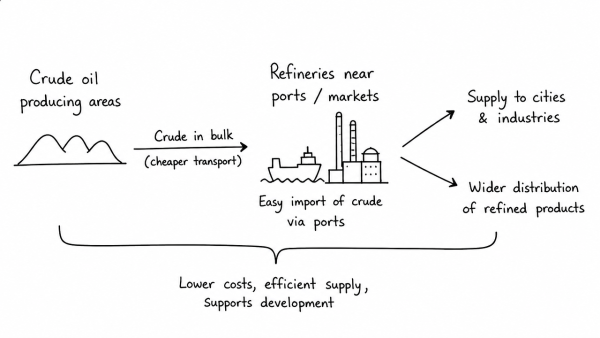
- Why this location choice?
- Crude oil is moved in bulk and is cheaper to transport than finished products.
- Refining near ports reduces handling costs and makes import of crude easier through deep-water terminals.
- Refineries near cities and industries serve major demand centres efficiently.
- Economic implications
- It helps developing countries save foreign exchange by importing crude and exporting higher-value petroleum products.
- It promotes industrial growth through petrochemicals, plastics, fertilisers and allied units.
- It creates jobs and supports port-led development and logistics networks.
- Strategic implications
- Such refineries increase dependence on seaborne supply and global freight routes.
- They are vulnerable to disruption at chokepoints such as narrow sea lanes and to price shocks in the world market.
- Coastal concentration also requires stronger naval, port and strategic reserve support.
- Regional and environmental implications
- It encourages the growth of industrial corridors and urban centres in coastal areas.
- However, it raises risks of marine pollution, oil spills and coastal damage from storms and rising sea levels.
- Refineries near population centres can also worsen air pollution and public health concerns.
Thus, the location of refineries away from crude fields is economically rational in developing countries, but it creates new challenges of import dependence, security, infrastructure needs and environmental risk.
Originally written on
August 31, 2026
and last modified on
August 31, 2026.