Persian literary sources of medieval India reflect the spirit of the age. Comment. (UPSC 2020)
Persian literary sources of medieval India were not mere court records. They reflected the political, social, religious and cultural energies of their time, while also revealing the tensions within a changing empire. Their value lies in showing both the ideals rulers projected and the realities they had to manage.
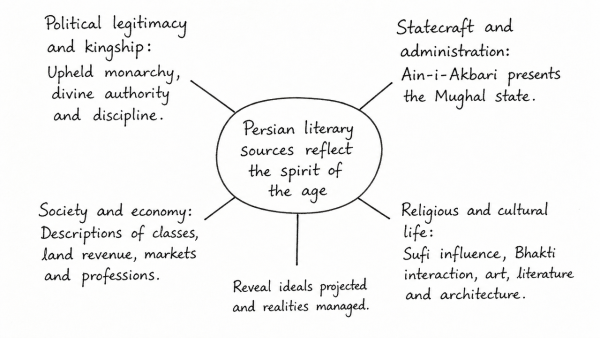
- Political legitimacy and kingship: Chronicles such as Tabaqat-i-Nasiri and Tarikh-i-Firoz Shahi upheld monarchy, divine authority and discipline. Barani’s writings also show the struggle between shariat and administrative needs in a largely non-Muslim society.
- Statecraft and administration: Ain-i-Akbari presents the Mughal state as an organised system of revenue, mansabdari and regulation. It mirrors the rise of a centralised, rational administration.
- Composite culture: Amir Khusrau’s works celebrate India’s seasons, fauna, languages and landscape, showing emotional attachment to the land. Translation works such as Razmnama and Dara Shikoh’s Sirr-i-Akbar reveal efforts at cultural synthesis.
- Religion and social life: Malfoozat literature records Sufi teachings, emphasising humanism, tolerance and spiritual equality. This reflects the appeal of Sufism in everyday society.
- Conflict and debate: Badauni’s criticism of Akbar shows that medieval India was not culturally uniform. It had sharp ideological contestation between orthodoxy and liberalism.
At the same time, these sources were shaped by court patronage and elite bias, so they often idealised rulers and ignored the masses. Even so, they remain rich evidence of a period marked by conquest, administration, pluralism and intellectual exchange.
Originally written on
September 2, 2026
and last modified on
September 2, 2026.