“Parliament’s power to amend the Constitution is limited power and it cannot be enlarged into absolute power.” In light of this statement explain whether Parliament under Article 368 of the Constitution can destroy the Basic Structure of the Constitution by expanding its amending power. (UPSC 2019)
Parliament under Article 368 has a wide power to amend the Constitution, but it is not an unlimited or sovereign power. The Constitution is supreme, and Parliament is only a constituent authority created by it.
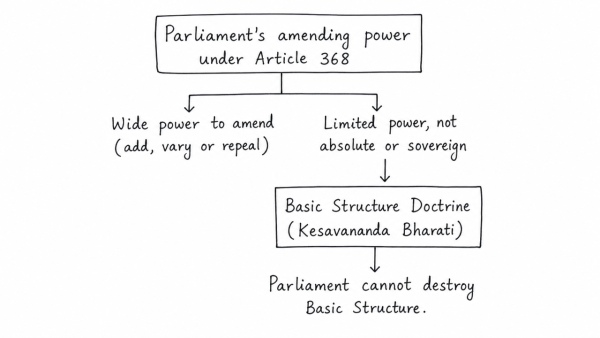
- Nature of Article 368: It permits addition, variation or repeal of constitutional provisions, but only within constitutional limits.
- Kesavananda Bharati: The Supreme Court held that Parliament can amend any part of the Constitution, but cannot damage or destroy its Basic Structure.
- Meaning of limited power: An amendment power is meant to change the Constitution, not to abolish its identity or convert itself into absolute power.
- Minerva Mills: The Court struck down the 42nd Amendment provision that said there would be “no limitation whatever” on Parliament’s amending power. It ruled that the limited nature of this power is itself part of the Basic Structure.
- Core features protected: Supremacy of the Constitution, judicial review, separation of powers, federalism, rule of law, and balance between Fundamental Rights and Directive Principles cannot be destroyed.
The donee of a limited power cannot, by exercising that power, convert it into an absolute one.
Therefore, Parliament cannot expand Article 368 so as to destroy the Basic Structure. Any attempt to do so would be unconstitutional and liable to be struck down by the judiciary. The power to amend is real and significant, but it remains bounded by the Constitution’s essential identity.
Originally written on
September 1, 2026
and last modified on
September 1, 2026.