“Once a Speaker, always a Speaker”! Do you think the practice should be adopted to impart objectivity to the office of the Speaker of Lok Sabha? What could be its implications for the robust functioning of parliamentary business in India? (UPSC 2020)
The phrase captures an ideal: the Speaker should be above party politics and seen as an impartial guardian of the House. In India, however, the office is often linked to the ruling party, which affects trust in its neutrality.
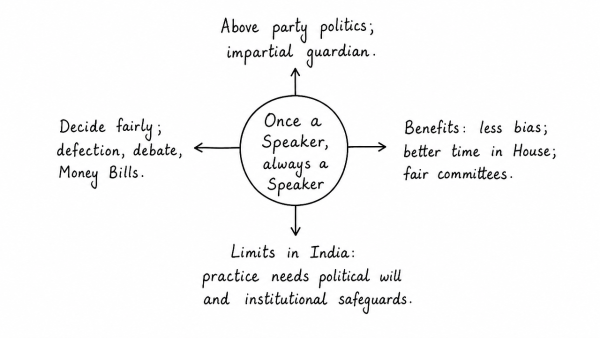
- Why adopt it? A Speaker who severs party ties can decide defection cases, regulate debate and certify Money Bills with greater objectivity.
- Institutional gains: It would reduce allegations of bias, improve time allocation in the House, and encourage fair referral of Bills to committees.
- Limits in India: The Westminster practice rests on a strong convention, while India has a fragmented multi-party system and no secure post-retirement arrangement for Speakers.
- Need for reform: Along with party neutrality, India may need an independent tribunal for anti-defection cases and a clearer code of conduct for the Speaker.
Thus, the convention should be adapted in spirit, not copied mechanically. A more neutral Speaker can strengthen parliamentary discipline, but real objectivity will depend on wider institutional safeguards and political consensus.
Originally written on
September 2, 2026
and last modified on
September 2, 2026.