On what grounds can a people’s representative be disqualified under the Representation of People Act, 1951? Also, mention the remedies available to such a person against his disqualification. (UPSC 2019)
Under the Representation of the People Act, 1951, a people’s representative can be disqualified mainly for criminal, electoral and financial misconduct, or for holding incompatible interests. The Act works with Articles 102 and 191 of the Constitution, which allow Parliament to prescribe such disqualifications.
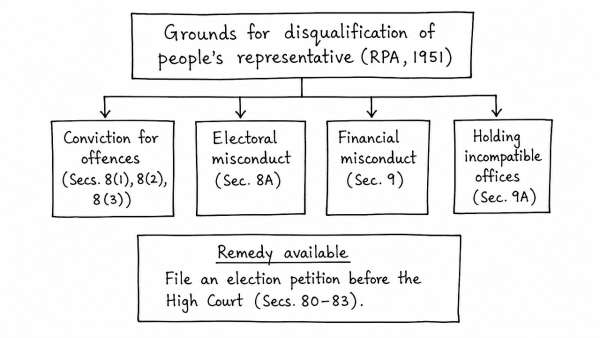
- Conviction for offences: Under Sections 8(1), 8(2) and 8(3), disqualification follows conviction for certain serious offences such as promoting enmity, bribery, rape, offences under special laws, social and economic offences, or any other offence with a sentence of two years or more. The ban generally lasts six years after conviction or release, as applicable.
- Corrupt electoral practices: Under Section 8A, a person found guilty of corrupt practice under Section 123, such as bribery or misuse of religion/caste in elections, may be disqualified for up to six years.
- Service-related misconduct: Under Section 9, dismissal from government service for corruption or disloyalty attracts disqualification for five years.
- Contract and profit conflicts: Sections 9A and 10 disqualify a person who has a subsisting government contract or holds an office of profit in specified government-controlled bodies.
- Election expense default: Under Section 10A, failure to lodge election expense accounts properly can lead to disqualification for three years.
- Stay or setting aside of conviction by a higher court can remove the disqualification.
- Appeal against conviction or sentence before the competent appellate court.
- Removal or reduction of disqualification by the Election Commission under Section 11, where permitted by law.
- For election disputes, an Election Petition lies to the High Court, with further appeal to the Supreme Court.
Thus, the Act seeks to protect electoral integrity, while appellate and statutory remedies ensure that disqualification is not used unfairly or without legal scrutiny.
Originally written on
September 1, 2026
and last modified on
September 1, 2026.