National Urban Transport Policy emphasises on ‘moving people’ instead of ‘moving vehicles’. Discuss critically the success of the various strategies of the Government in this regard. (UPSC 2014)
National Urban Transport Policy shifts focus from moving vehicles to moving people, stressing access, equity and sustainability.
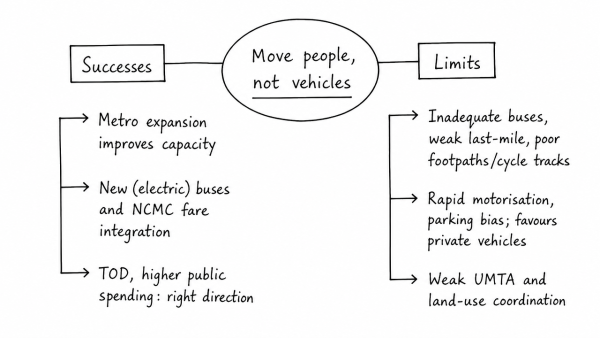
- Gains: Metro expansion has improved capacity in many cities. New bus schemes, especially electric buses, and fare integration through NCMC support public transport. Transit-oriented development and higher public spending also signal the right direction.
- Limits: Urban bus fleets remain inadequate, last-mile connectivity is weak, and footpaths/cycle tracks are often poor. Rapid motorisation, parking bias and fragmented urban governance still favour private vehicles. UMTA and land-use coordination remain weak, so many citizens lack seamless, affordable mobility.
Overall, the strategy is correct and has created visible transport assets, but its impact is uneven and incomplete; success requires stronger bus systems, non-motorised transport, parking restraint and empowered city-level planning.
Originally written on
August 29, 2026
and last modified on
August 29, 2026.