National Human Rights Commission (NHRC) in India can be most effective when its tasks are adequately supported by other mechanisms that ensure the accountability of a government. In light of the above observation assess the role of NHRC as an effective complement to the judiciary and other institutions in promoting and protecting human rights standards. (UPSC 2014)
NHRC is an important statutory watchdog for life, liberty, equality and dignity under the Protection of Human Rights Act, 1993. It is most effective when its work is backed by courts, police reforms, State Human Rights Commissions and responsive governments.
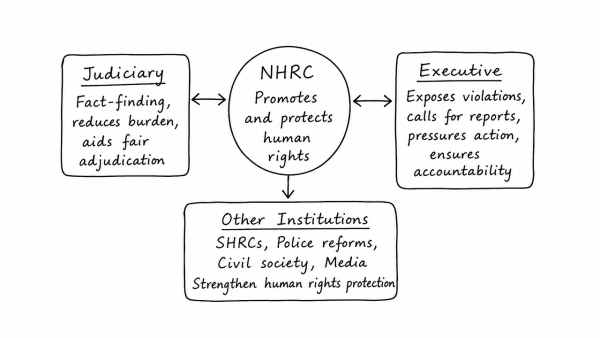
- Complement to judiciary: It conducts fact-finding, reduces the burden on courts, and can recommend interim relief. Its reports often help courts in complex custodial death, encounter and prison abuse cases.
- Bridge with executive: NHRC exposes violations, calls for reports, and pressures authorities to act. This improves accountability where victims fear retaliation or lack access to courts.
- Support to other institutions: It works with SHRCs and specialised bodies for women, children, SCs and STs, widening reach to vulnerable groups.
- Limits: Its recommendations are largely advisory, it lacks its own investigative cadre, faces delays, and cannot effectively probe armed forces cases.
Thus, NHRC is not a substitute for courts, but a valuable complement. With stronger compliance, transparency and institutional support, it can better translate rights into real protection.
Originally written on
August 29, 2026
and last modified on
August 29, 2026.