Multiplicity of various commissions for the vulnerable sections of the society leads to problems of overlapping jurisdiction and duplication of functions. Is it better to merge all commissions into an umbrella Human Rights Commission? Argue your case. (UPSC 2018)
India’s system of commissions for vulnerable groups has increased visibility and access to justice, but it has also created overlap, parallel inquiries and delay. The real question is whether administrative neatness should outweigh specialised protection.
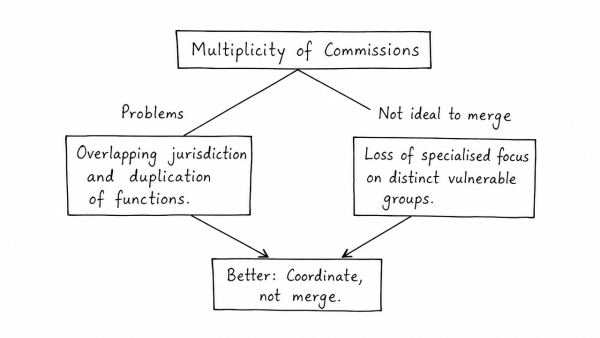
- Why overlap happens: Many vulnerabilities are intersecting. A Dalit woman, tribal child or disabled minority person may fall within the mandate of several commissions at once. This leads to duplicated notices, forum shopping and conflicting recommendations.
- Why a full merger is not ideal: These bodies are not identical. NCSC, NCST and NCBC have constitutional status, while NCW, NCPCR, NCM and the disability body are statutory. Their mandates require distinct expertise, field focus and treaty-linked responsibilities.
- Limits of an umbrella NHRC: NHRC is already burdened and its recommendations are advisory. Absorbing all commissions into one body may weaken specialised attention, reduce accountability and over-centralise power.
| Better approach | Why |
| Coordination, not merger | Preserves expertise while reducing duplication |
| Common complaint portal | Ensures single-window entry and proper routing |
| Shared databases and joint hearings | Prevents multiple inquiries into the same case |
| Time-bound inter-commission referral | Improves speed and clarity |
Thus, a complete merger into one Human Rights Commission is neither practical nor desirable. India needs functional convergence, stronger coordination and clearer division of work, while retaining specialised commissions to protect the specific needs of vulnerable groups.
Originally written on
September 1, 2026
and last modified on
September 1, 2026.