Money laundering poses a serious security threat to a country’s economic sovereignty. What is its significance for India and what steps are required to be taken to control this menace? (UPSC 2013)
Money laundering is not merely tax evasion; it is the conversion of crime proceeds into apparently lawful wealth. For India, it weakens economic sovereignty by distorting markets, harming public revenue and financing organised crime and terror networks.
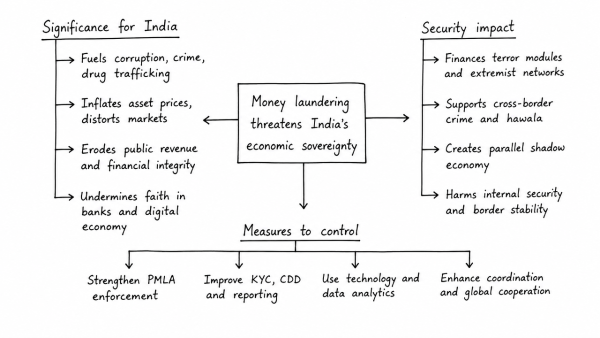
- Significance for India: It fuels corruption, drug trafficking, cyber fraud and shell companies, and can inflate asset prices. It also undermines faith in banks and the digital economy.
- Security impact: Dirty money supports terror modules, cross-border crime and a parallel shadow economy, affecting internal security and border stability.
- Control measures: Strengthen PMLA enforcement with faster trials, more Special Courts and time-bound disposal.
- Expand scrutiny of politically exposed persons, virtual asset service providers and other vulnerable sectors.
- Use AI-based analytics, real-time FIU data sharing and stronger inter-agency coordination.
- Promote beneficial ownership disclosure, strict KYC, and quicker asset attachment and confiscation.
Thus, India needs a balanced approach: strong enforcement, better regulation and efficient justice, so that financial growth remains transparent, secure and sovereign.
Originally written on
August 29, 2026
and last modified on
September 7, 2026.