Mention the significance of straits and isthmus in international trade. (UPSC 2022)
Straits and isthmuses are vital geographical features that shape global trade routes. They act as natural or man-made gateways through which a large share of world shipping moves, making them central to trade efficiency, energy security and geopolitics.
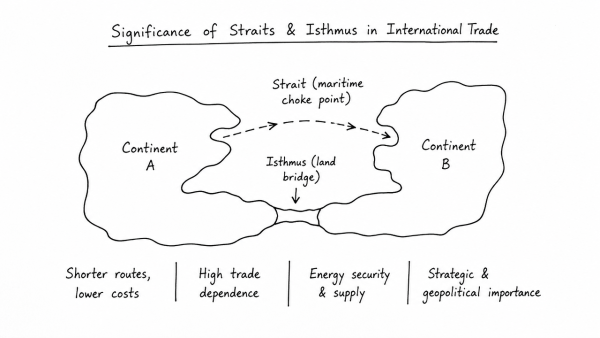
- Straits as maritime choke points: Narrow sea passages such as the Strait of Malacca, Hormuz and Bab-el-Mandeb connect major water bodies and concentrate shipping traffic. This reduces route options but also makes them crucial for the movement of oil, gas, containers and bulk cargo.
- High trade dependence: Important straits carry a very large share of global seaborne trade and energy supplies. Any disruption due to conflict, piracy or accidents can raise freight costs, delay deliveries and push up insurance premiums.
- Geopolitical significance: Because they are narrow and easily monitored, straits are vulnerable to blockades and military tension. Control over them can influence regional power balances and global commodity prices.
- Isthmuses as short-cuts for trade: Isthmuses are narrow land bridges between two larger land masses. By cutting canals through them, trade routes are shortened sharply, as seen in the Suez Canal and Panama Canal.
- Economic gains: Such canals save time, fuel and shipping costs, reduce voyage distance and improve fleet efficiency. They also support faster movement of perishable and time-sensitive goods.
- Strategic alternatives: Where canals are congested or vulnerable, states may develop alternative corridors, land bridges or pipelines to secure supply chains.
Thus, straits and isthmuses are not just physical features; they are trade arteries. Their role in lowering transport costs is matched by their strategic importance, since any disruption can affect national economies and global commerce.
Originally written on
September 3, 2026
and last modified on
September 3, 2026.