Mention the salient features of ‘Mission Drishti’. Discuss the imaging techniques used in the satellite launched on 3rd May 2026. Why is it being considered the world’s first satellite of its kind? (UPSC 2026)
Mission Drishti is a major step in India’s private space and Earth observation capability. Launched on 3 May 2026 aboard SpaceX Falcon 9 from Vandenberg, it is built by Bengaluru-based GalaxEye Space and is India’s largest privately made Earth observation satellite.
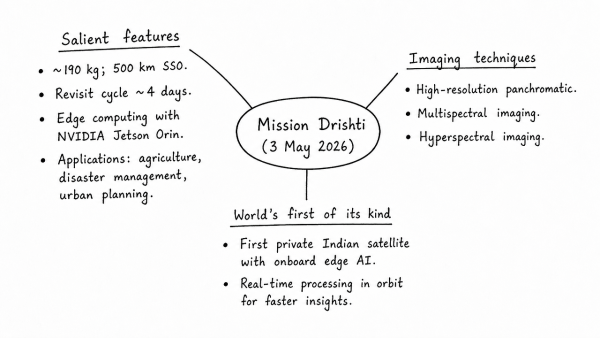
Salient features
- Mass and orbit: About 190 kg, placed in a 500 km sun-synchronous low Earth orbit.
- Revisit capability: Designed for a revisit cycle of around four days, useful for frequent monitoring.
- Onboard processing: Uses edge computing with NVIDIA Jetson Orin for real-time data processing in orbit.
- Use cases: Supports precision agriculture, insurance, urban planning, border surveillance, maritime tracking and disaster response.
Imaging techniques used
- Synthetic Aperture Radar (SAR): An active X-band radar that works day and night and can see through clouds, smoke and rain. It gives sharp images up to 0.9 m resolution in spotlight mode.
- Electro-optical multispectral imaging: A passive sensor capturing seven bands, including RGB, near-infrared, coastal blue and red edge, to produce clear and familiar colour images.
- Simultaneous co-registration: Both radar and optical data are captured at the same time and from the same viewing angle, reducing mismatch and improving fusion.
- Data fusion: The combined output gives analysis-ready imagery with a spatial resolution of about 1.2 to 3.6 m.
Why it is the world’s first of its kind
It is the first commercial satellite to integrate multispectral optical imaging and active radar imaging on a single operational platform. This removes the usual trade-off between readable colour images and all-weather radar images, making the output both intuitive and reliable. By fusing both sensors in one satellite, it offers a new model for persistent, high-quality Earth observation.
Originally written on
September 6, 2026
and last modified on
September 6, 2026.