Mention core strategies for the transformation of aspirational districts in India and explain the nature of convergence, collaboration and competition for its success. (UPSC 2018)
India’s aspirational districts programme seeks to fast-track development in the most lagging regions by improving human development outcomes and governance. Its design rests on measurable targets, local initiative and strong administrative support, rather than on large new schemes alone.
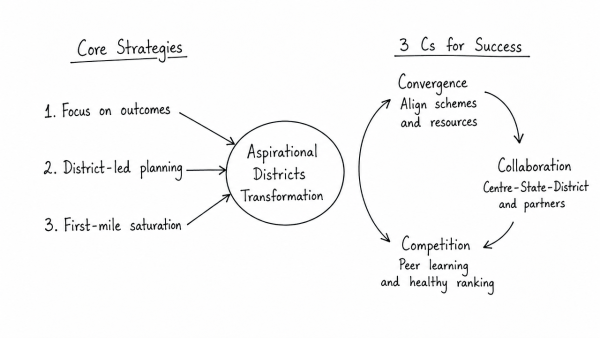
- Core strategies
- Focus on outcomes: Progress is tracked through key performance indicators in health and nutrition, education, agriculture and water resources, financial inclusion and skill development, and basic infrastructure.
- District-led planning: District Collectors are given space to prepare local action plans suited to local needs.
- First-mile saturation: The aim is to ensure full coverage of essential services such as immunisation, sanitation, nutrition, school facilities and drinking water.
- Real-time monitoring: Performance dashboards help in tracking gaps, identifying bottlenecks and correcting course quickly.
- Administrative support: Central and state officers are attached as in-charge officers to strengthen delivery on the ground.
- Nature of the 3 Cs
- Convergence: It means combining schemes of different departments for one district goal. For example, health, education, rural development and livelihood programmes are aligned to reduce fragmentation and avoid duplication.
- Collaboration: It implies cooperation among the Centre, states, districts, civil society and private partners. This brings resources, technical support and better last-mile delivery.
- Competition: Districts are compared on improvement, not on absolute position. This creates peer pressure, healthy rivalry and a “race to the top”.
Thus, the programme succeeds when schemes work together, institutions cooperate across levels, and districts are motivated to improve continuously. The 3 Cs convert backwardness into a shared mission of measurable and inclusive growth.
Originally written on
August 31, 2026
and last modified on
August 31, 2026.