Many voices had strengthened and enriched the nationalist movement during the Gandhian phase. Elaborate. (UPSC 2019)
The Gandhian phase was not shaped by Gandhi alone. It became a broad national arena where diverse social groups and ideological currents entered the struggle, giving it mass depth, new concerns and wider legitimacy.
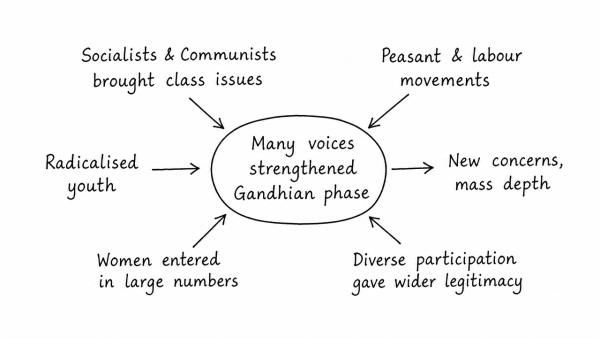
- Socialists and communists brought class issues into nationalism. The Communist Party of India (1925) and the Congress Socialist Party (1934) linked freedom with workers’ and peasants’ rights. The Meerut Conspiracy Case gave them a public platform and helped radicalise youth.
- Peasant and labour movements expanded the social base of the Congress. The All India Kisan Sabha, formed in 1936, demanded end of zamindari and relief from rural debt. Trade unions such as AITUC connected industrial strikes with the anti-colonial struggle.
- Revolutionary voices added courage and urgency. Bhagat Singh and the HSRA gave nationalism a secular and socialist tone. Subhas Chandra Bose offered an alternative path through the Forward Bloc and the INA, inspiring mass patriotism.
- Dalit leadership, especially B.R. Ambedkar, forced nationalism to confront caste oppression. The Poona Pact showed that political freedom had to be linked with social justice and representation.
- Women entered public politics in large numbers through civil disobedience and Quit India. Leaders like Sarojini Naidu, Aruna Asaf Ali and Sucheta Kripalani widened participation beyond the male elite.
- Business and constitutional voices also strengthened the movement. FICCI backed indigenous enterprise, while the Karachi Resolution of 1931 gave the freedom struggle a clear social and economic programme.
Thus, the Gandhian phase became a composite national movement. Its strength lay in the interaction of class, caste, gender and ideological voices, which transformed a political agitation into a wider struggle for social and economic freedom.
Originally written on
September 1, 2026
and last modified on
September 1, 2026.