Many State Governments further bifurcate geographical administrative areas like Districts and Talukas for better governance. In light of the above, can it also be justified that more number of smaller States would bring in effective governance at State level? Discuss. (UPSC 2013)
Administrative convenience is a valid reason for redrawing districts or talukas, because it brings officials closer to people and improves service delivery. But the same logic cannot be applied mechanically to States, as a State is a full constitutional, fiscal and political unit.
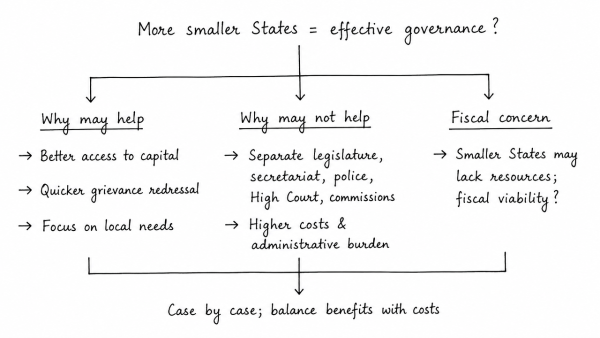
- Why smaller States may help: better access to the capital, quicker grievance redressal, and focus on local needs, especially in backward, tribal or hill areas.
- Why they may not: new States need separate legislature, secretariat, police, high court and commissions, raising costs and administrative burden.
- Fiscal concern: many small States have narrow tax bases and depend heavily on central transfers.
- Political risk: smaller assemblies can be unstable and prone to coalition conflicts.
- Governance alternative: stronger decentralisation, empowered local bodies, and better district administration may deliver gains without new States.
Thus, smaller States can improve governance only where regional identity, viability and administrative efficiency align. As a general rule, statehood is not a universal cure; careful case-by-case assessment is essential.
Originally written on
August 28, 2026
and last modified on
September 7, 2026.