Major cities of India are becoming more vulnerable to flood conditions. Discuss. (UPSC 2016)
Major Indian cities are becoming more flood-prone because rapid urban growth is outpacing planning, drainage and ecosystem protection. Climate change has also made rainfall more erratic, with shorter but far more intense spells.
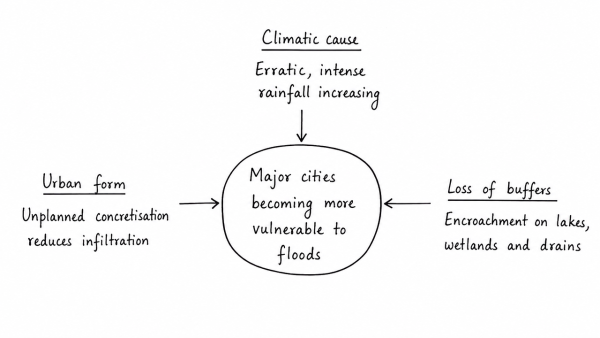
- Climatic causes: Heavy rainfall is rising across many tehsils. In built-up catchments, flood peaks and volumes increase sharply, so water collects and moves faster.
- Urban form: Unplanned concretisation reduces infiltration. Bengaluru’s built-up area rose from 8% to nearly 74%, while green cover fell steeply.
- Loss of buffers: Encroachment on lakes, wetlands and natural drains in cities such as Chennai, Hyderabad and Bengaluru has reduced storage during storms.
- Poor drainage: Old, silted and blocked storm-water systems cannot handle present-day rainfall intensity.
- Governance gaps: Many cities lack statutory master plans, coordination and trained planners, weakening flood control.
Thus, urban flooding is not only a weather problem but also a planning and governance failure. Cities need blue-green infrastructure, protected wetlands, better drainage, and risk-sensitive urban planning.
Originally written on
August 30, 2026
and last modified on
August 30, 2026.