“Latecomer” Industrial Revolution in Japan involved certain factors that were markedly different from what the West had experienced. (UPSC 2013)
Japan’s industrial revolution was a latecomer process and differed sharply from the West. It was not a slow, private, market-led change, but a rapid, state-guided transformation after the Meiji Restoration.
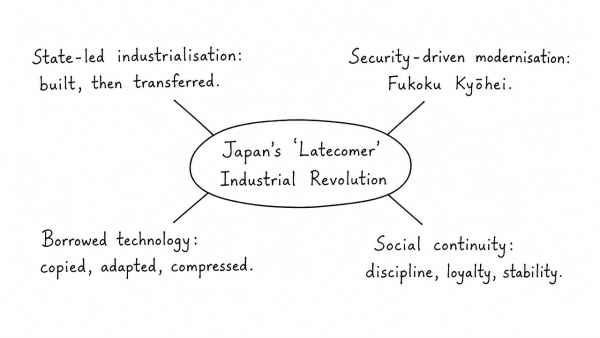
- State-led industrialisation: The government built model factories, shipyards, mines and railways, then transferred them to private hands.
- Security-driven modernisation: The aim was Fukoku Kyōhei — rich country, strong army — to resist Western domination after unequal treaties.
- Borrowed technology: Japan selectively copied and adapted Western machines, experts and methods, compressing decades into a few years.
- Social continuity: Existing discipline, loyalty and hierarchy were used in factories, unlike the social upheaval seen in the West.
- Zaibatsu and education: Family conglomerates grew with state support, while mass schooling and technical training created skilled labour.
Thus, Japan’s industrialisation was fast, planned and defensive, combining modern technology with strong state direction and traditional social values.
Originally written on
August 28, 2026
and last modified on
September 6, 2026.