Justify the need for FDI for the development of the Indian economy. Why is there a gap between MOUs signed and actual FDIs? Suggest remedial steps to be taken for increasing actual FDIs in India. (UPSC 2016)
FDI is vital for India’s growth because domestic savings alone cannot finance the huge needs of infrastructure, manufacturing and technology. It also brings stable long-term capital, unlike volatile portfolio flows, and helps improve productivity, exports and employment.
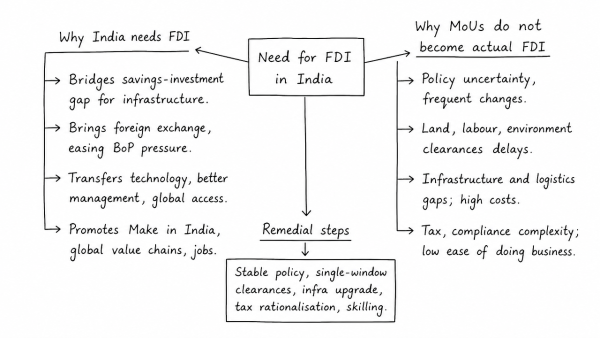
- Why India needs FDI
- Bridges the savings-investment gap for roads, power, logistics and digital assets.
- Brings foreign exchange, reducing pressure on the balance of payments.
- Transfers technology, better management and global market access.
- Promotes Make in India, global value chain integration and formal job creation.
- Why MoUs do not become actual FDI
- MoUs are often only expressions of intent, not binding investment commitments.
- Project delays arise from land acquisition, environmental clearances and local opposition.
- Multiple approvals, policy uncertainty and tax concerns reduce investor confidence.
- Poor infrastructure, weak contract enforcement and long dispute resolution add cost.
- State-level announcements may exceed ground-level execution capacity.
- Remedial steps
- Make approvals time-bound through a genuine single-window system.
- Create land banks and plug-and-play industrial parks with basic utilities.
- Ensure stable, predictable tax and sectoral policies.
- Speed up courts and commercial dispute settlement.
- Improve coordination between Centre, states and local bodies, with project tracking.
Thus, India must convert investment intent into execution by lowering friction, improving certainty and building investor-ready infrastructure. Only then will FDI rise in both volume and quality, supporting inclusive and sustainable development.
Originally written on
August 30, 2026
and last modified on
August 30, 2026.