Judicial legislation is antithetical to the doctrine of separation of powers as envisaged in the Indian Constitution. In this context, justify the filing of large number of public interest petitions praying for issuing guidelines to executive authorities. (UPSC 2020)
Judicial legislation does raise concerns under separation of powers because law-making is primarily the task of Parliament and the State legislatures. Yet, in India, the Constitution does not adopt a rigid separation of powers; it builds a system of checks, balances, judicial review and protection of rights.
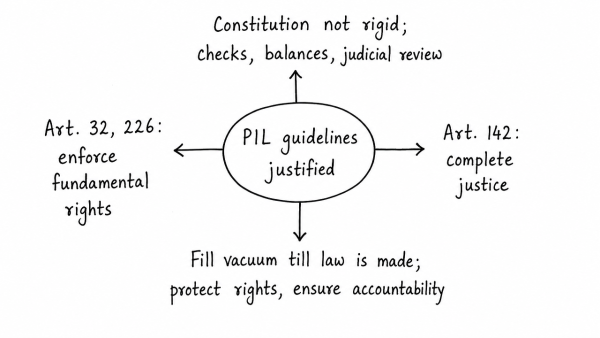
- Constitutional basis for limited judicial directions: Articles 32 and 226 empower courts to enforce fundamental rights. Article 142 allows the Supreme Court to do complete justice, especially where legal gaps exist.
- Fill the vacuum till law is made: PILs seeking guidelines are often filed when the legislature is silent or delayed on urgent social issues. Such directions are interim, not permanent substitutes for legislation.
- Prevent executive arbitrariness: Courts intervene when authorities act without fair procedure, as in matters of custodial violence, sexual harassment, demolition drives, environmental harm and digital privacy.
- Protect the vulnerable: PILs give access to those who cannot easily approach law-making bodies, such as undertrials, workers, women and marginalised groups.
- Ensure rule of law: Judicial guidelines often set minimum safeguards, transparency and accountability, reducing abuse until proper statutory rules are enacted.
The Supreme Court has itself cautioned against becoming a “super-legislature”, but has also recognised that constitutional silence cannot leave rights unprotected.
Thus, while judicial legislation must remain exceptional and restrained, PILs praying for guidelines are justified where there is a rights-infringing vacuum, executive excess or urgent need for procedural fairness. They strengthen, rather than weaken, constitutional governance when used as temporary bridges to valid legislation.