It is argued that the strategy of inclusive growth is intended to meet the objectives of inclusiveness and sustainability together. Comment on this statement. (UPSC 2019)
The strategy of inclusive growth seeks not only faster growth, but also fair access to its benefits. In India, this is increasingly linked with sustainability, because growth that ignores environment, water, energy and soil can deepen exclusion in the long run.
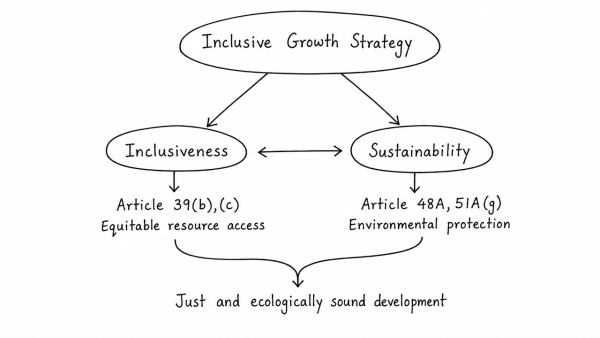
- Inclusiveness and sustainability reinforce each other: Article 39(b) and (c) support equitable distribution of resources, while Article 48A and Article 51A(g) require environmental protection. Together, they show that development must be both just and ecologically sound.
- Social inclusion through green delivery: PM Ujjwala Yojana reduces drudgery and indoor pollution for poor women, while PM Surya Ghar aims to ease energy poverty through rooftop solar. Jal Jeevan Mission expands safe water access and also stresses rainwater harvesting, greywater reuse and recharge of sources.
- Livelihoods with lower ecological cost: PM-KUSUM supports farmer incomes through solar pumps and land leasing, while cutting diesel use and carbon emissions. PM-PRANAM encourages balanced fertiliser use, reducing cost pressure and soil damage.
- SDG linkage: The approach fits the idea of “Leaving No One Behind” and the 5Ps of the SDGs: People, Planet, Prosperity, Peace and Partnership.
However, the linkage is not automatic. High transition costs, slow fund release, weak local capacity and unequal access to technology can exclude the poor if safeguards are absent.
Thus, inclusive growth is rightly designed to achieve inclusiveness and sustainability together. Its success depends on efficient implementation, targeted subsidies, climate-resilient infrastructure and a strong focus on the most vulnerable.
Originally written on
September 1, 2026
and last modified on
September 1, 2026.