Is diversity and pluralism in India under threat due to globalisation? Justify your answer. (UPSC 2020)
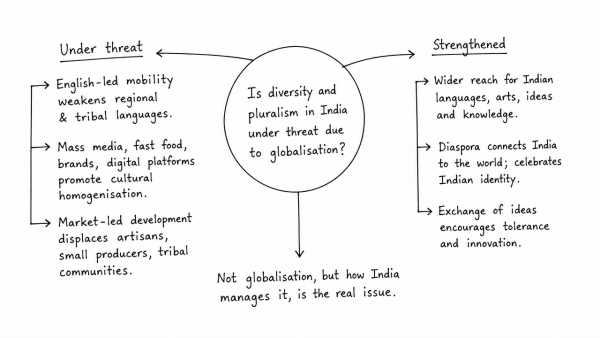
Globalisation has both pressured and strengthened India’s diversity. It can promote uniform consumer culture, but it has also widened the reach of Indian languages, arts and ideas. The real issue is not globalisation itself, but how India manages it.
- How diversity is under threat
- English-led mobility and migration can weaken intergenerational use of regional and tribal languages. UNESCO lists many Indian languages as endangered.
- Mass media, fast food, branded fashion and digital platforms can encourage cultural homogenisation, especially among urban youth.
- Market-led development may displace artisans, small producers and tribal communities, reducing space for local customs and livelihoods.
- How globalisation can also support pluralism
- It allows Indian culture to travel globally through yoga, cinema, cuisine and performing arts, creating pride in local identities.
- Digital tools help preserve languages and traditions through translation, documentation and online learning.
- E-commerce and GI tags protect crafts by connecting local producers to wider markets and preventing imitation.
- Why the answer is nuanced
- India is not a passive victim. Its Constitution protects cultural and linguistic rights through Articles 29 and 30, and tribal safeguards through the Fifth and Sixth Schedules.
- Globalisation becomes harmful when it is unregulated and market-centred; it becomes beneficial when linked with cultural protection and inclusive growth.
Thus, diversity and pluralism in India are not under absolute threat, but they face real pressures from homogenising trends. With strong cultural policy, education in mother tongues, protection of artisans and local self-rule, India can use globalisation to deepen, rather than dilute, its plural civilisation.
Originally written on
September 2, 2026
and last modified on
September 2, 2026.