“Investment in infrastructure is essential for more rapid and inclusive economic growth.” Discuss in the light of India’s experience. (UPSC 2021)
Investment in infrastructure is vital for faster and more inclusive growth because it raises productivity, lowers logistics costs and connects people, firms and regions. India’s experience shows that sustained public capex can both lift GDP and broaden opportunity.
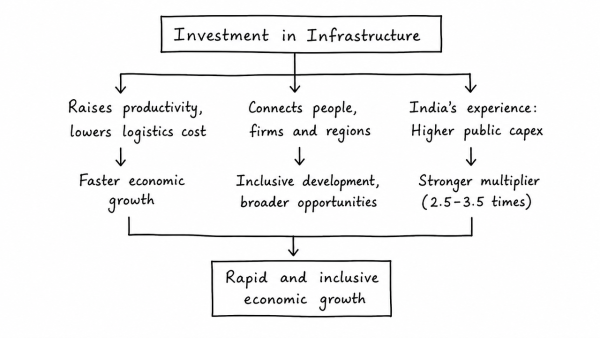
Rapid growth: Public capital expenditure has risen sharply, from ₹2 lakh crore in FY 2014-15 to ₹12.2 lakh crore in FY 2026-27, with effective capex at ₹17.15 lakh crore. Such spending has a strong multiplier, estimated at 2.5-3.5 times over the medium term. Expanded highways, ports and freight corridors cut transport time, improve industrial efficiency and support exports; India’s logistics cost is estimated at 7.9% of GDP, while port turnaround time has fallen to 0.9 days.
Inclusive growth: Digital Public Infrastructure has widened access to finance and services. UPI and Aadhaar have helped raise formal banking inclusion from 25% in 2008 to over 80% today. In rural areas, greater digital and physical connectivity has aided business registrations, savings, female entrepreneurship and reduced dependence on informal borrowing. Housing, sanitation, rural roads and BharatNet have also improved living standards and narrowed the rural-urban divide.
Private investment and balance: Better roads, energy and digital networks reduce business risk and crowd in private investment; the national highway network reached 1,46,560 km by December 2025, strengthening manufacturing clusters and supply chains.
However, infrastructure alone is insufficient; India must improve project planning, land acquisition, state capacity, maintenance and environmental safeguards, while linking investment with skills, jobs and balanced regional development.