International civil aviation laws provide all countries complete and exclusive sovereignty over the airspace above their territory. What do you understand by ‘airspace’? What are the implications of these laws on the space above this airspace? Discuss the challenges which this poses and suggest ways to contain the threat. (UPSC 2014)
Airspace means the column of atmosphere above a state’s land and territorial waters, over which it has complete and exclusive sovereignty. Under the Chicago Convention, foreign aircraft cannot enter this zone without consent.
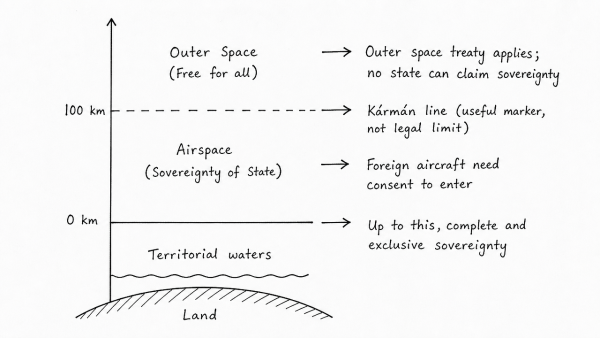
- Vertical issue: No treaty fixes where airspace ends and outer space begins. The Kármán line of 100 km is a useful scientific marker, not a binding legal limit.
- Outer space regime: Beyond airspace, outer space is free for use by all under the Outer Space Treaty, and no state can claim sovereignty there.
- Challenges: The grey zone of near space creates disputes over balloons, drones, suborbital flights and hypersonic weapons. It also complicates launches, re-entry, surveillance and air traffic safety.
- Containment: States should agree a clear boundary, create rules for near-space transit, improve ICAO-UNOOSA coordination, and mandate advance notification of risky flights and launches.
A clear legal framework is needed so that sovereignty, freedom of use and safety are balanced, while preventing militarisation and accidental escalation.
Originally written on
August 29, 2026
and last modified on
August 29, 2026.