Instances of President’s delay in commuting death sentences has come under public debate as denial of justice. Should there be a time limit specified for the President to accept/reject such petitions? Analyse. (UPSC 2014)
The President’s power under Article 72 is a constitutional safety valve, but mercy petitions cannot remain pending for years. In death cases, delay itself can become punishment, causing extreme mental agony and raising doubts about fair procedure under Article 21.
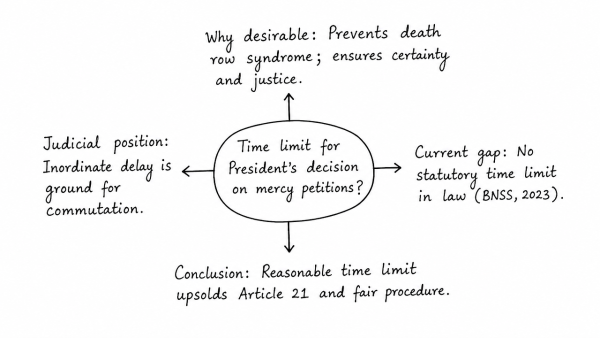
- Why a time limit is desirable: It will prevent “death row syndrome”, reduce political or administrative procrastination, and give certainty to convicts, victims and society.
- Judicial position: The Supreme Court has held that inordinate, unexplained delay in deciding mercy petitions is a valid ground for commutation.
- Current gap: BNSS, 2023 fixes timelines for filing and forwarding petitions, but not for the President’s final decision.
- Caution: A rigid deadline may hinder careful examination in complex cases involving security, multiple offenders, or diplomatic issues.
A balanced approach is better: prescribe a reasonable outer limit with provision for recorded reasons in exceptional cases. This would protect human dignity without weakening the constitutional mercy power.
Originally written on
August 29, 2026
and last modified on
August 29, 2026.