Initially Civil Services in India were designed to achieve the goals of neutrality and effectiveness, which seems to be lacking in the present context. Do you agree with the view that drastic reforms are required in Civil Services? Comment. (UPSC 2017)
Yes, to a large extent. The civil services were created as a neutral, efficient and rule-bound “steel frame” of governance, but in practice they now face politicisation, delay and weak accountability. Reform is therefore necessary, though it should be deep and calibrated, not destructive.
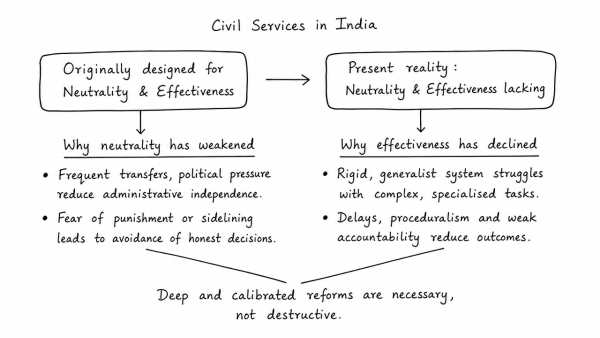
- Why neutrality has weakened: Frequent transfers, pressure from political executives and selective use of “public interest” postings reduce administrative independence. Officers often avoid honest decisions because of fear of punishment or sidelining.
- Why effectiveness has declined: A rigid, generalist system often struggles with complex areas such as digital governance, climate policy, health systems and infrastructure. File-based procedures, slow decision-making and shortage of staff further weaken delivery.
- Need for structural reform: Fixed tenure, transparent transfer rules, and recording of oral instructions in writing can protect impartiality. Stronger Civil Services Boards must be made truly effective.
- Need for competency-based service: Mission Karmayogi and e-learning through iGOT show the right direction towards role-based and skill-based administration. More mid-career specialisation and selective lateral entry can bring domain knowledge.
- Need for accountability: Performance assessment should focus on outcomes, citizen service and ethical conduct, not only seniority. At the same time, integrity safeguards and protection for honest officers must be strengthened.
However, drastic reform should not mean undermining the constitutional neutrality of civil services. The aim should be to make them more professional, responsive and ethical, while preserving the impartiality needed in a democracy. In this sense, major reforms are essential, but they must be reformative, not destabilising.
Originally written on
August 31, 2026
and last modified on
August 31, 2026.