“Industrial growth rate has lagged-behind in the overall growth of Gross-Domestic-Product (GDP) in the post-reform period.” Give reasons. How far are the recent changes in Industrial Policy capable of increasing the industrial growth rate? (UPSC 2017)
Industrial growth has lagged GDP growth in the post-reform period because India’s expansion has been services-led, while manufacturing has remained subdued and the industrial share has stayed broadly stagnant.
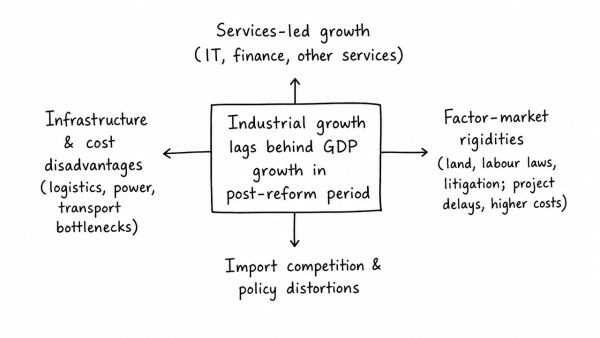
- Services-led pattern: Growth was driven by IT, finance and other services, unlike the manufacturing-led take-off seen in East Asia.
- Infrastructure and cost disadvantages: High logistics costs, power shortages, weak transport links and other bottlenecks reduce competitiveness.
- Factor-market rigidities: Slow land acquisition, litigation, and uneven labour-law implementation raise project delays and costs.
- Import competition and policy distortions: Lower tariffs exposed firms to cheap imports; inverted duty structures often discourage domestic value addition.
- Credit and technology constraints: MSMEs face limited formal credit, high borrowing costs and low R&D, which hurts productivity and innovation.
Policy changes: PLI schemes, GatiShakti, the National Logistics Policy, single-window clearances, land-bank measures and labour-code reforms can improve investment, connectivity, supply-chain depth and ease of doing business.
However, these reforms are mostly sector-specific and incentive-based; they can raise output in selected industries, but sustained industrial acceleration needs cheaper credit, deeper MSME support, faster land and labour reforms, higher R&D, and a stable tax-trade regime.
Originally written on
August 31, 2026
and last modified on
August 31, 2026.