India’s Traditional Knowledge Digital Library (TKDL), which has a database containing formatted information on more than 2 million medicinal formulations, is proving a powerful weapon in the country’s fight against erroneous patents. Discuss the pros and cons of making this database publicly available under open-source licensing. (UPSC 2015)
India’s TKDL is a strong defence against wrongful patents because it converts codified traditional knowledge into searchable prior art. Opening it fully could widen access, but it would also raise serious risks for ownership, benefit-sharing and commercial misuse.
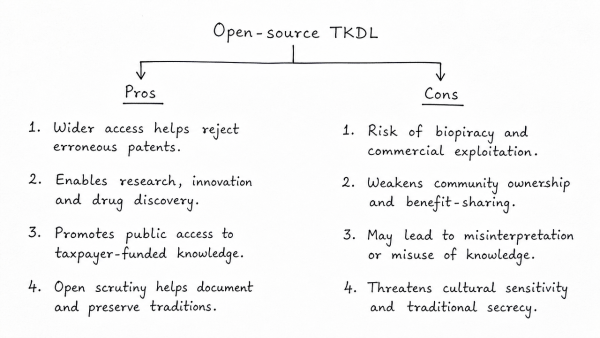
- Pros:
- Global access would help more patent offices reject erroneous claims.
- Researchers, start-ups and universities could use it for drug discovery and validation.
- It would improve public access to knowledge funded by taxpayers.
- Open scrutiny may help document and preserve fragile oral traditions.
- Cons:
- It may aid biopiracy and enable firms to patent slight variations.
- It can weaken access and benefit-sharing under biodiversity law.
- Traditional knowledge holders may lose chances of fair returns.
- Monitoring misuse across borders would be difficult.
A balanced path is better: expand controlled access, protect sensitive knowledge, and use TKDL to prevent misuse while ensuring fair benefit-sharing for communities.
Originally written on
August 30, 2026
and last modified on
August 30, 2026.