Indian Philosophy and tradition played a significant role in conceiving and shaping the monuments and their art in India. Discuss. (UPSC 2020)
Indian monuments are not mere works of stone; they are built expressions of philosophy, faith and social values. From temple plans to sculpture and layout, art in India has often translated abstract ideas into visible form. This is why architecture here carries both aesthetic beauty and spiritual meaning.
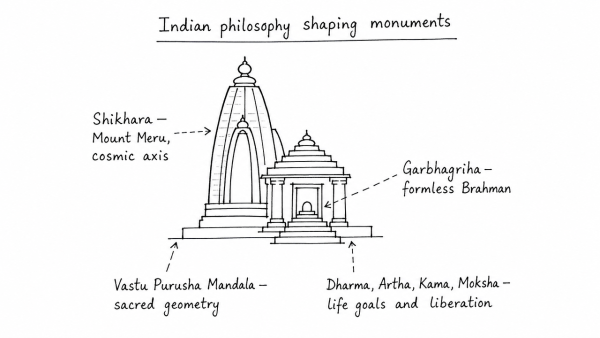
- Temple architecture as cosmic order: The Vastu Purusha Mandala gave temples a sacred geometry. The garbhagriha symbolised the formless Brahman, while the shikhara or vimana evoked Mount Meru, the cosmic axis linking earth and heaven.
- Life goals and liberation: Temples such as Khajuraho and Konark present dharma, artha, kama and moksha through sculpture. The outer walls reflect worldly life, while the inner sanctum leads the devotee towards spiritual uplift.
- Buddhist and Jain ideals: The Sanchi Stupa and rock-cut caves at Ajanta and Karle express impermanence, meditation and the path to nirvana. Jain monuments such as Gommateshwara and Dilwara highlight asceticism, ahimsa and the many-sided nature of truth.
- Bhakti and temple art: Under Bhakti, art became more emotional and personal. The Chola bronzes, especially Nataraja, show Shiva’s cosmic dance, linking devotion with creation, preservation and destruction.
- Composite and regional traditions: Indo-Islamic buildings used symmetry, calligraphy and geometric design to reflect monotheism. At places like Ajmer and Fatehpur Sikri, Sufi ideas encouraged open and inclusive sacred spaces.
Thus, Indian monuments are cultural texts in stone and metal. They show that philosophy in India did not remain abstract; it shaped space, form and ornament, giving architecture a deeply spiritual and human character.
Originally written on
September 2, 2026
and last modified on
September 2, 2026.