Indian diaspora has an important role to play in South-East Asian countries’ economy and society. Appraise the role of Indian diaspora in South-East Asia in this context. (UPSC 2017)
Indian diaspora in South-East Asia is one of the oldest and most influential overseas Indian communities. Spread across Malaysia, Singapore, Myanmar, Indonesia, Thailand and the Philippines, it contributes not only to economic growth but also to social and cultural life.
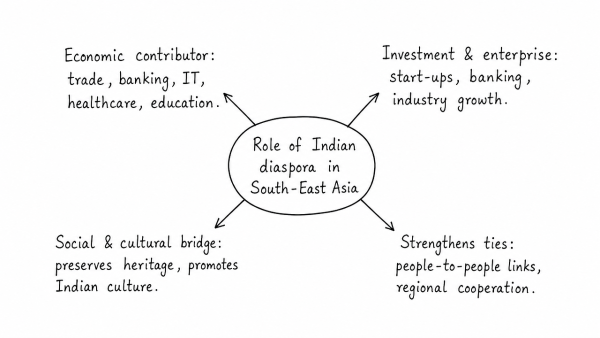
- Economic role: Indians are important in trade, banking, IT, healthcare, education and small business. In Singapore, Indian-origin professionals are well placed in civil services, finance and the judiciary. In Malaysia and Thailand, they support industry, services and medical care.
- Investment and enterprise: Indian entrepreneurs have built technology start-ups, strengthened banking networks and widened business links with India. The diaspora also helps attract investment and expand India-ASEAN commercial ties.
- Remittances and digital links: Migrant workers and professionals send large remittances home. New digital payment links, such as UPI-PayNow between India and Singapore, make cross-border transfers faster and cheaper.
- Social contribution: The community acts as a bridge of languages, religions and traditions. Tamil, Hindi and Punjabi communities preserve identity while helping integration in host societies. Indian temples, cultural bodies and educational networks add to pluralism and social cohesion.
- Soft power: Through festivals, food, cinema, education and philanthropy, the diaspora projects India’s civilisational links and supports the Act East Policy.
| Strengths | Constraints |
| Economic leadership, skilled manpower, cultural influence, people-to-people ties | Historical marginalisation, statelessness in some cases, and tighter local hiring norms |
Thus, the Indian diaspora in South-East Asia is a valuable asset for regional development and India’s foreign policy. Its full potential can be realised by protecting vulnerable groups, improving skill mobility and deepening economic and cultural partnerships.
Originally written on
August 31, 2026
and last modified on
August 31, 2026.