Indian Constitution exhibits centralising tendencies to maintain unity and integrity of the nation. Elucidate in the perspective of the Epidemic Diseases Act, 1897; the Disaster Management Act, 2005 and recently passed Farm Acts. (UPSC 2020)
India’s Constitution is federal in form, but contains centralising features to protect unity, integrity and effective governance during crises. Parliament has residuary powers, Union law prevails in Concurrent List conflicts, and the Centre can issue binding directions to States.
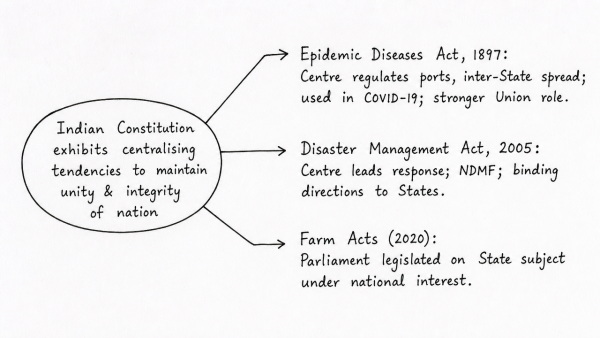
Epidemic Diseases Act, 1897: Though public health is largely a State matter, the Act empowered the Centre to regulate ports and inter-State spread during epidemics. Its use during COVID-19, and the later provision making violence against health workers cognisable and non-bailable, showed Union-led response to a nationwide health emergency.
Disaster Management Act, 2005: Since “disaster management” is not expressly listed, Parliament legislated using residuary power. The Act created a national framework under the NDMA, chaired by the Prime Minister, enabling coordinated, binding measures such as lockdowns, movement restrictions and standard protocols across States.
Farm Acts, 2020: Despite agriculture being a State subject, the Centre relied on Entry 33 of the Concurrent List relating to trade, foodstuffs and distribution. The Acts expanded Union influence over agricultural trade and reduced State control over mandis and levies, but their repeal reflected the limits of centralisation without cooperative federalism.
Thus, these laws show that Indian federalism is tilted towards the Centre when national interests demand it, but legitimacy depends on consultation and respect for State autonomy.