India has achieved remarkable successes in unmanned space missions including the Chandrayaan and Mars Orbiter Mission, but has not ventured into manned space missions. What are the main obstacles to launching a manned space mission, both in terms of technology and logistics? Examine critically. (UPSC 2017)
India’s unmanned missions show strong design skills, but human spaceflight is a far tougher test. A crewed mission demands near-zero failure, life support, safe return and rescue systems, all of which raise risk, cost and coordination needs sharply.
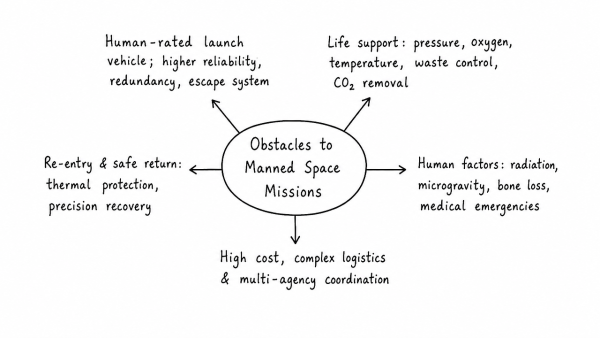
- Technology: launch vehicles must be human-rated with higher reliability, redundancy and a crew escape system.
- Life support: cabin pressure, oxygen, temperature, waste control and carbon-dioxide removal must work flawlessly.
- Re-entry: the crew module needs advanced thermal protection and precise splashdown or landing recovery.
- Human factors: radiation, microgravity, bone loss and medical emergencies need extensive bioastronautic research.
- Logistics: astronaut training, test facilities, mission control, tracking, and search-and-rescue arrangements are costly and complex.
Critically, India’s frugal space model suited planetary probes, but human spaceflight needs sustained funding, strict certification and industrial maturity. Yet the present Gaganyaan effort shows these obstacles are difficult, not insurmountable.
Originally written on
August 31, 2026
and last modified on
August 31, 2026.