“Increasing cross-border terrorist attacks in India and growing interference in the internal affairs of several member-states by Pakistan are not conducive for the future of SAARC (South Asian Association for Regional Cooperation).” Explain with suitable examples. (UPSC 2015)
Cross-border terrorism and interference in domestic affairs have eroded SAARC’s credibility and reduced it to a forum of weak cooperation.
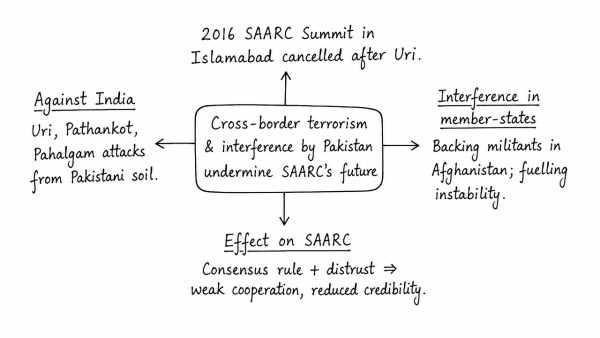
- Against India: Repeated terrorist attacks from Pakistani soil, including Uri, Pathankot and later Pahalgam, hardened India’s stance. The 2016 SAARC Summit in Islamabad was cancelled after Uri, showing how terrorism blocks summit-level diplomacy.
- Interference in member-states: Pakistan is accused of backing militant groups in Afghanistan and fuelling instability in the region. Such actions violate the principle of non-interference and create distrust among smaller states.
- Effect on SAARC: Since decisions require unanimity, one hostile member can stall progress. SAFTA, connectivity and counter-terror cooperation have suffered, while countries increasingly prefer BIMSTEC and other sub-regional forums.
Thus, unless Pakistan ends support for terrorism and respects sovereignty, SAARC cannot realise its regional integration potential.
Originally written on
August 30, 2026
and last modified on
August 30, 2026.