“In the villages itself no form of credit organization will be suitable except the cooperative society.” – All India Rural Credit Survey. Discuss this statement in the background of agricultural finance in India. What constraints and challenges do financial institutions supplying agricultural finance face? How can technology be used to better reach and serve rural clients? (UPSC 2014)
The statement is largely valid: village credit needs local, low-cost, participatory institutions for small, seasonal loans, which cooperatives and PACS can provide better than distant formal lenders. However, weak governance and uneven performance have reduced their effectiveness.
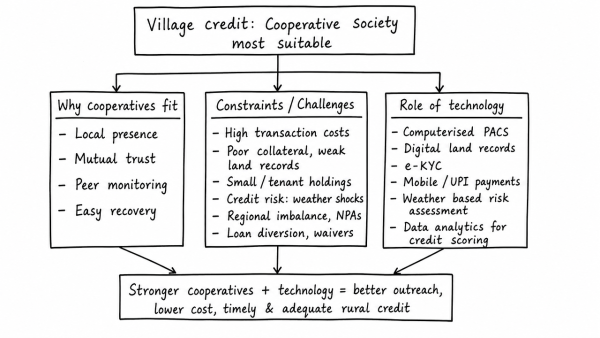
- Why cooperatives fit: local presence, mutual trust, peer monitoring and easier recovery.
- Constraints on institutions: high transaction costs, poor collateral, weak land records, small/tenant holdings, credit risk from weather shocks, regional imbalance, NPAs, loan diversion and dependence on waivers.
- Technology: computerised PACS, digital land records, e-KYC, mobile/UPI payments, satellite-weather based risk assessment and the Unified Lending Interface can cut costs and speed lending.
Hence, cooperatives should remain the village core of agricultural finance, but only a blended model of cooperatives, banks and fintech, backed by reforms and digital tools, can expand inclusive rural credit.
Originally written on
August 29, 2026
and last modified on
August 29, 2026.