“In the Indian governance system, the role of non-state actors has been only marginal.” Critically examine this statement. (UPSC 2015)
Non-state actors are no longer marginal in Indian governance. Civil society, SHGs, industry, think tanks and pressure groups now shape policy, delivery and accountability, though their space remains uneven and contested.
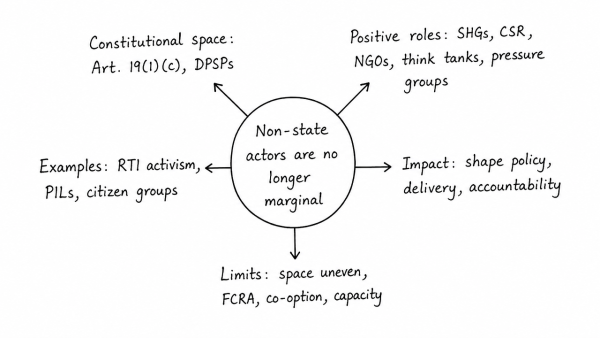
- Why they matter: Article 19(1)(c) protects associations, while DPSPs encourage welfare collaboration. SHG-bank linkage, CSR, RTI activism and PILs show co-governance in practice.
- Positive roles: SHGs drive women’s credit and livelihoods; CSR funds education, health and environment; think tanks provide policy inputs; NGOs monitor schools, elections and rights; citizen groups expose corruption.
- Limits: Their impact is constrained by FCRA controls, dependence on funding, weak reach in poorer states, and occasional elite capture. Negative actors such as extremists and cyber groups also distort governance space.
Thus, the statement is only partly true. Non-state actors are not marginal in function, but their influence is fragmented, regulated and socially unequal. A stronger partnership model, with transparency and autonomy, can make governance more participatory and effective.
Originally written on
August 30, 2026
and last modified on
August 30, 2026.