‘In the context of the neo-liberal paradigm of developmental planning, multi-level planning is expected to make operations cost-effective and remove many implementation blockages.’ Discuss. (UPSC 2019)
In the neo-liberal paradigm, developmental planning is less about state-led production and more about enabling markets, coordinating actors, and ensuring efficient delivery. Multi-level planning fits this approach because it brings decision-making closer to citizens while improving convergence across Union, State, district and local levels.
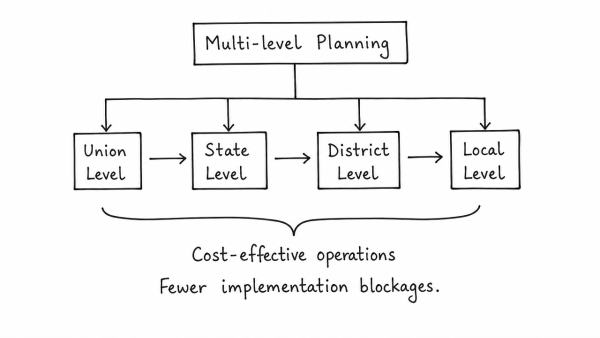
- Why it is cost-effective
- Local bodies can identify real needs, avoiding uniform and wasteful spending.
- Articles 243G, 243W and 243ZD provide the constitutional base for decentralised planning through PRIs, ULBs and District Planning Committees.
- Outcome-linked devolution and audit-based grants encourage discipline, transparency and better use of public funds.
- Scheme convergence at district level reduces duplication and allows infrastructure, agriculture, health and welfare schemes to reinforce each other.
- How it removes implementation blockages
- Bottom-up planning reduces information gaps between the state and local reality.
- People’s Plan campaigns and digital platforms such as eGramSwaraj help prepare local plans and monitor execution.
- PM GatiShakti improves inter-ministerial coordination through GIS-based planning, reducing delays in land, utility and logistics clearances.
- Aspirational Blocks and similar focused programmes target weak areas with convergence and competition, helping overcome chronic delivery failures.
- Limits
- Uneven capacity of local institutions, weak data systems, and inadequate fiscal autonomy can dilute benefits.
- State-level political and administrative interference may still block genuine decentralisation.
- Without strong accountability, multi-level planning can become a paper exercise.
Thus, multi-level planning can make development more efficient and remove bottlenecks, but only when backed by real devolution, skilled local institutions, fiscal support and cooperative federalism. In a neo-liberal framework, it works best as a mechanism for smarter governance rather than a substitute for committed state capacity.
Originally written on
September 1, 2026
and last modified on
September 1, 2026.