In the context of the diversity of India, can it be said that the regions form cultural units rather than the States? Give reasons with examples for your viewpoint. (UPSC 2017)
India’s diversity is better understood through regions than through administrative States. Cultural life grows from language, ecology, trade, migration and shared memory, so it often crosses political borders.
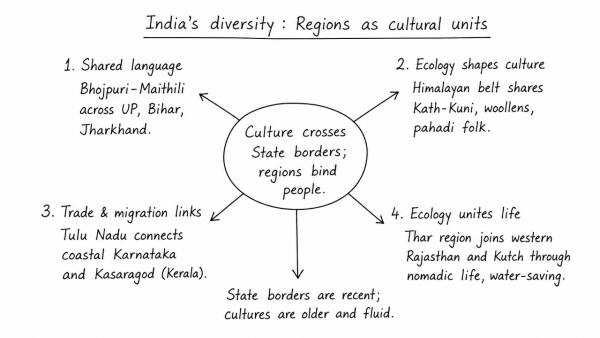
- Regions as cultural units: Bhojpuri-Maithili spread across eastern UP, Bihar and Jharkhand; Tulu Nadu links coastal Karnataka and Kasaragod in Kerala.
- Ecology shapes culture: The Himalayan belt shares Kath-Kuni architecture, woollen crafts and pahadi folk traditions; the Thar region unites western Rajasthan and Kutch through nomadic habits and water-saving practices.
- State borders are recent: Many States were formed for administration and language, but culture is older and more fluid. Konkani culture, for example, connects Goa, coastal Maharashtra and north Karnataka.
- Policy recognition: Zonal Cultural Centres and cultural mapping projects accept that India’s living traditions are sub-state and trans-state.
However, States remain important for patronage, official language and heritage management. Thus, regions are the deeper cultural units, while States are useful political frameworks that often contain multiple, overlapping cultural worlds.
Originally written on
August 31, 2026
and last modified on
August 31, 2026.