How will I2U2 (India, Israel, UAE and USA) grouping transform India’s position in global politics? (UPSC 2022)
I2U2 can transform India from a largely bilateral player in West Asia into a more visible minilateral power. By linking India with the UAE, Israel and the USA, it gives India a platform to shape outcomes in trade, technology, food, energy and regional security.
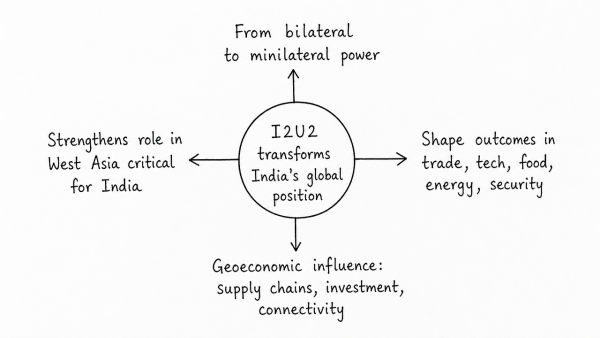
- Strategic rise in West Asia: India moves beyond balancing rival partners to working within an institutional framework. This strengthens its role in a region vital for energy, remittances and sea lanes.
- Geoeconomic influence: I2U2 supports supply-chain diversification, investment and connectivity. It complements projects such as the India-Middle East-Europe Economic Corridor, improving India’s access to Europe and the Gulf.
- Food and energy security: Joint projects in smart agriculture, food parks, renewable energy and water management can make India a key node in regional resilience, not just a market.
- Technology and innovation: Cooperation in start-ups, space, climate data, AI and green technology can raise India’s profile as a partner in solutions, not merely a consumer of capital.
- Security and balancing: The grouping helps India strengthen maritime awareness in the Western Indian Ocean and offers a soft balance against China’s growing presence in the region.
| Shift in India’s image | Result |
| From hedging to shaping | Greater agenda-setting power |
| From bilateral ties to minilateral coalitions | Deeper strategic relevance |
Thus, I2U2 enhances India’s global standing as a bridge between regions, a provider of public goods, and a confident advocate of strategic autonomy through issue-based partnerships.
Originally written on
September 3, 2026
and last modified on
September 3, 2026.