How is the Government of India protecting traditional knowledge of medicine from patenting by pharmaceutical companies? (UPSC 2019)
India protects traditional medical knowledge from patenting by pharmaceutical firms through a mix of law, databases and community-level safeguards. The aim is to stop monopoly claims over knowledge that already belongs to the public domain or to indigenous communities.
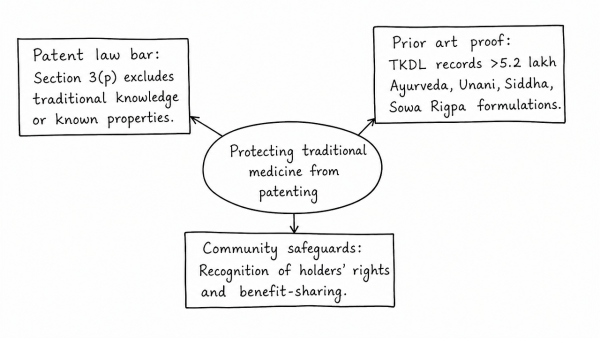
- Patent law bar: Section 3(p) of the Patents Act, 1970 excludes inventions that are in effect traditional knowledge, or mere duplication of known properties of traditionally known ingredients.
- Prior art proof: The Traditional Knowledge Digital Library (TKDL) records more than 5.2 lakh formulations and practices from Ayurveda, Unani, Siddha, Sowa Rigpa and Yoga in major international languages, so patent examiners can detect old knowledge easily.
- Patent office scrutiny: TKDL access is shared with several foreign patent offices, which helps prevent wrong grants and speeds up objections against applications based on Indian traditional medicine.
- Biodiversity control: Under the Biological Diversity Act, prior approval and benefit-sharing rules apply when Indian biological resources are used. This checks biopiracy and ensures communities get a fair share.
- Community records: People’s Biodiversity Registers, maintained by Biodiversity Management Committees, document local medicinal knowledge and act as evidence against private patent claims.
- Case support: Courts have upheld rejection of patents based on Panchagavya-style traditional formulations, reinforcing that old knowledge cannot be turned into private property.
Thus, India uses legal exclusion, digital documentation, biodiversity regulation and local record-keeping to defend traditional medicine from misappropriation while still encouraging genuine innovation.
Originally written on
September 1, 2026
and last modified on
September 1, 2026.