How is efficient and affordable urban mass transport key to the rapid economic development of India? (UPSC 2019)
Efficient and affordable urban mass transport is a key enabler of India’s rapid economic development because it reduces congestion costs, improves labour mobility and makes cities more productive and competitive. In a fast-urbanising economy, transport is not just a welfare service but core economic infrastructure.
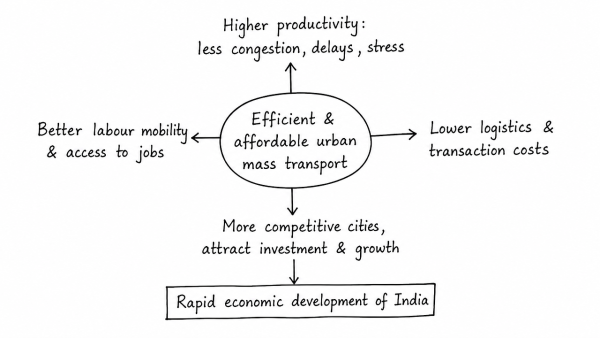
Growth effects
- Higher productivity: Mass transit cuts travel delays, fuel waste and stress; congestion in major metros causes large annual output losses and reduces effective working hours.
- Lower logistics and transaction costs: Shifting commuters from roads to metros, buses and suburban rail frees road space for freight and business travel, improving supply-chain efficiency.
- Wider labour markets: Affordable transport expands the daily reach of jobs, helping firms access a larger workforce and workers access better opportunities without costly migration.
- More inclusive growth: Safe and reliable transit especially benefits women and low-income groups by improving access to education, employment and public services.
Why it is economically efficient
- High returns: Urban transport investments often yield strong direct and indirect gains through time savings, lower vehicle costs and higher land values.
- Energy and environmental benefits: Mass transit reduces fuel use, oil dependence and urban pollution, supporting sustainable growth.
Therefore, efficient and affordable urban mass transport acts as a growth multiplier by raising productivity, lowering costs, deepening inclusion and enabling sustainable urbanisation, making it central to India’s economic strategy.
Originally written on
September 1, 2026
and last modified on
September 1, 2026.