How has the emphasis on certain crops brought about changes in cropping patterns in recent past? Elaborate the emphasis on millets production and consumption. (UPSC 2018)
Recent emphasis on selected crops is reshaping Indian cropping patterns from cereal-dominated farming to more diversified, climate-resilient and market-linked choices. This change reflects policy support, demand shifts, nutrition goals and environmental stress, especially in water-scarce regions.
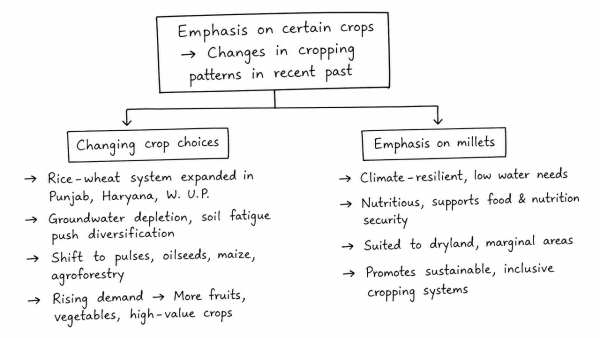
- Changing crop choices: In Punjab, Haryana and western Uttar Pradesh, the rice-wheat system has expanded, but groundwater depletion and soil fatigue are pushing diversification towards pulses, oilseeds, maize and agroforestry. Rising urban demand and export potential have also expanded area under fruits, vegetables and other high-value crops. Earlier subsidy patterns favoured water- and input-intensive crops; recent efforts seek better alignment with agro-climatic suitability and sustainability.
- Millet production: Millets are being promoted because they need less water, grow well in poor soils and dryland areas, and suit semi-arid regions. India remains the largest millet producer, with Rajasthan, Maharashtra, Karnataka and Uttar Pradesh as major contributors. MSP support, quality seeds and state initiatives are helping revive cultivation.
- Millet consumption: Millets are rich in fibre, minerals and protein, have a low glycaemic index and are gluten-free. Their inclusion in PDS, ICDS and PM POSHAN is expanding regular demand, while processed millet products are improving consumer acceptance.
Thus, cropping patterns are increasingly shaped by profitability, nutrition and sustainability, and millet promotion strengthens both farm diversification and food security.
Originally written on
September 1, 2026
and last modified on
September 1, 2026.