How has Indian agriculture been transformed from food scarcity to food surplus level? Explain the various government policies implemented for diversification of Indian agriculture. (UPSC 2026)
Indian agriculture has moved from chronic scarcity in the 1960s to food surplus through a mix of technology, public investment and policy support. From dependence on imported grain under PL-480, it has become self-sufficient in foodgrains and a major agri-exporter.
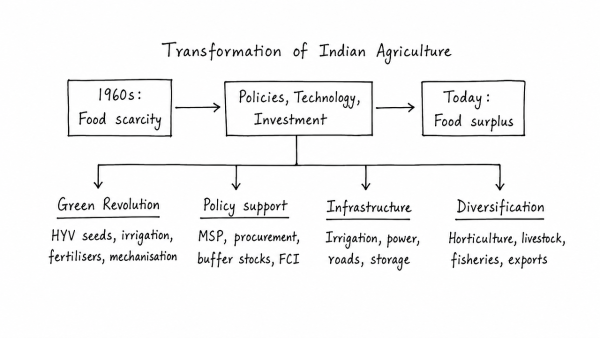
- Green Revolution: Adoption of HYV seeds, assured irrigation, fertilisers, mechanisation and extension services sharply raised wheat and rice output.
- Support institutions: MSP, procurement, buffer stocks and the FCI reduced risk for farmers and ensured market assurance.
- Infrastructure push: Expansion of canals, tube wells, rural roads, power and storage improved productivity and reduced post-harvest losses.
- Horticulture and allied sectors: Diversification into fruits, vegetables, dairy, fisheries and livestock raised income and reduced dependence on cereals alone.
- Current surplus: Foodgrain production has touched record levels, while horticulture output has also crossed foodgrain output, showing a shift to high-value agriculture.
Policies for diversification
- Crop diversification: PM Dhan-Dhaanya Krishi Yojana, Crop Diversification Programme and support for pulses, oilseeds and millets in stress-prone districts.
- Price and procurement support: Special procurement and MSP for pulses and oilseeds to reduce overdependence on paddy-wheat systems.
- Edible oil strategy: National Mission on Edible Oils-Oil Palm to expand domestic oilseed supply and reduce import dependence.
- Horticulture: Mission for Integrated Development of Horticulture for fruits, vegetables, spices and protected cultivation.
- Natural and organic farming: PKVY and National Mission on Natural Farming to improve soil health and open premium markets.
- Allied activities: PMMSY, dairy missions and AHIDF to promote livestock, fisheries and value addition.
Thus, India’s agriculture has shifted from subsistence to surplus by raising productivity, while diversification policies now aim at higher incomes, sustainability and nutritional security.
Originally written on
September 6, 2026
and last modified on
September 6, 2026.